Carbide inserts for specific applications
Selection of the correct carbide insert can save time and money when it comes to cutting metal, some grades of carbide can cover a number of material groups but there is always a trade off in overall performance either in tool life, limitation in cutting speed or both. Chip geometries also offer the same benefits, your one geometry cuts all has it’s limitations choosing an insert geometry made to cut a certain group of material is nearly always an advantage. The exception is for small batch or general machining where investing in a number of shapes and grades just to cut a certain material every so often is not worth the investment, for example you can often get away with using P35 coated grade intended for alloy steel for cutting stainless you can also use coated inserts in the M25-M35 range intended for stainless to cut most steels with reasonable tool life.
With this in mind most modern inserts are made with a grade & geometry to fit the application, many if not all brands offer inserts according to material group with suggested severity of cutting. A typical range would include the following. Finish turning of material group P (steel) would be P15 coated carbide with a geometry designed for a feed range of ~0.12-0.22mm, medium cutting would be P25 coated carbide with a feed range of ~0.20-0.45mm and a roughing geometry with P35 coated carbide with a feed range of ~0.3-0.5mm. About 80% of steel applications can be covered using the medium cutting inserts with P25 coated carbide.
To simplify selection of the correct insert some brands will give a description in the product code, lets look at the code for APT (Associated Production Tools Ltd) brand insert CNMG 120408 MP 1125, the first and second parts (CNMG 120408) of the code are according to ISO standards and give information on the shape, tolerance, style & dimensions. The the next two letters (MP) have been used to describe the chip groove geometry and in this case the supplier has used this to give information on the intended use the ‘M’ denotes medium cutting and the ‘P’ denotes material group P (steel).
Now lets look at the last four numbers ‘1125’ the supplier has used these to describe the make up of the grade and its intended use. The first two numbers (11–) denote the intended use and coating which in this case is material group P (1) with MT-CVD coating for material group P (1), (material group P is the first material group listed according to ISO 513). The last two numbers (–25) denote the range according to ISO 513 so we can be sure that inserts (from this brand)* in this grade are intended for cutting materials in group P25 application range.
*Be aware that chip geometry and grade descriptions are brand specific, many descriptions that look the same or similar from different brands may not be intended for the same applications and in fact may be the complete opposite. Most brands give further information on the label, normally the material group is listed with a solid box or circle donating the intended applications and an open box or circle showing extended applications (normally you would only use extended applications for small batch production or in emergency). If in doubt you should contact the supplier or one of their agents for more information.
The following are typical examples of carbide inserts made for specific material groups.
Carbide Inserts for turning Aluminium and non-ferrous metals are typically positive rake with micro polished surface and are periphery ground creating a sharp cutting edge this reduces the risk of the material sticking to the inserts resulting in built-up edge, these inserts can also be used for cutting copper alloys and plastic materials like nylon. Some machinists use these inserts for fine finishing of stainless but the feed range is limited due to the weakness of the sharp cutting edge. Some manufactures offer these inserts with PVD (Physical Vapor Deposition) coatings including TiN (Titanium Nitride), ZrN (Zirconium Nitride) and TiAlN (Titanium Aluminium Nitride), TiAlN can be an advantage when machining stainless.

Carbide Turning Insert Ground & Polished for Aluminium
Carbide Inserts for turning Carbon and Alloy Steel are typically negative rake with a negative land creating a strong cutting edge this helps with higher feed rates resulting in higher metal removal. Most shapes of inserts for this group of material are available double sided which provides more usable edges, positive inserts with a lesser negative land are used for small parts machining or fine finishing. Various coatings are used with these types of inserts but at the time of writing MT-CVD (Medium Temperature – Chemical Vapour Disposition) with multiple layers including TiCN (Titanium Carbo-Nitride), Al2O3 (Aluminium Oxide) & TiN (Titanium Nitride) are most common, conventional CVD is less common but can still be found on ‘economy’ inserts.
Many manufactures incorporate surface treatment to create a smoother surface of the insert to help cutting and reduce heat some newer grades have a layer of PVD coating on top of the CVD coating. Advanced CVD technologies which create a super smooth surface without any other treatment are available from a number of suppliers.

Carbide Turning Insert for Steel with advanced CVD coating
Carbide Inserts for turning Stainless Steel are typically negative rake with a positive or small negative land creating a balance between a strong and sharp cutting edge this helps with reduction of chip welding whilst maintaining a relatively strong cutting edge. Most shapes of inserts for this group of material are available double sided which provides more usable edges, positive inserts with a lesser negative land are used for small parts machining or fine finishing. These types of inserts are generally available in both MT-CVD and PVD coatings, a typical MT-CVD would contain three layers one each of TiCN-Al2O3-TiN or TiN-TiCN-TiN these inserts perform well for general turning of stainless. Typical PVD coatings would be TiAlN, TiN or TiAlN+TiN, PVD coatings cope better with difficult conditions and lower cutting speeds which are often encountered when cutting stainless.
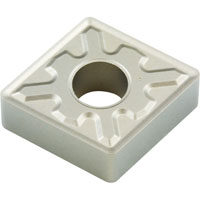
Carbide Turning Insert for Stainless Steel with MT-CVD coating
Carbide Inserts for turning Hi-Temp Alloys (sometimes referred to as super alloys) like Inconel, Waspaloy, Nimonic, Stellite etc. are often positive rake with a positive land and strengthened at the corner radius creating a balance between a strong and sharp cutting edge. Most shapes of inserts for this group of material are available double sided which provides more usable edges, positive inserts can be used for small parts machining, fine finishing or thin walled parts. These types of inserts are generally available with PVD and Multi-PVD coatings, base grades for these inserts can include small amounts of rare earths or precious metals like Rhodium. Typical PVD coatings would be TiAlN, TiN or TiAlN+TiN. Because of the materials and coatings used in these inserts they demand a premium in price, for small batch machining K20 uncoated carbide with a geometry intended for stainless can be used instead.

Carbide Turning Insert for Hi-Temp Alloys with Multi-PVD (TiAlN+TiN) coating
A wide range of Carbide Inserts are available on-line from shop-apt.co.uk
 Carbide Cutting Tools News & Views